

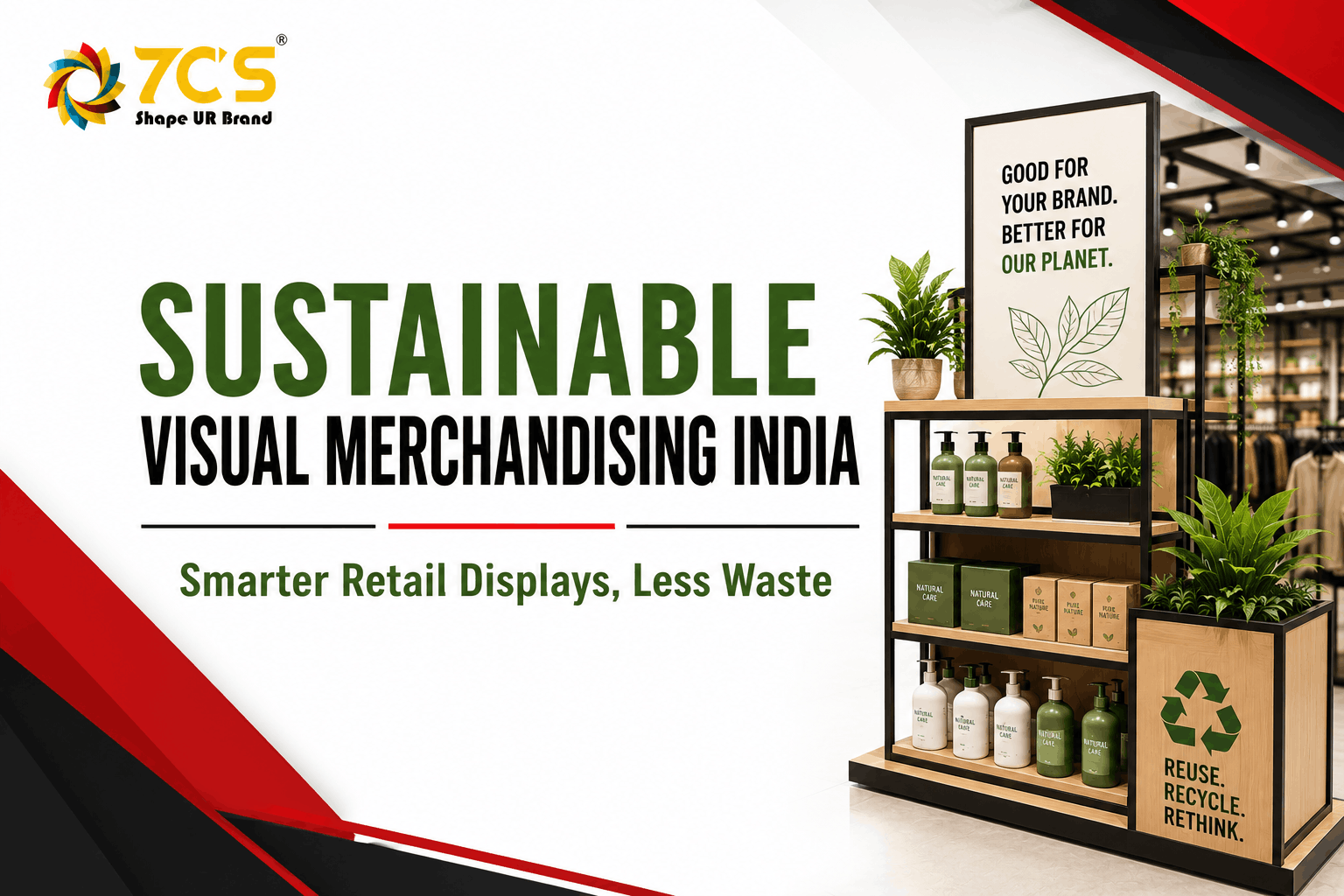
Sustainable Visual Merchandising India: Smarter Retail Displays, Less Waste
Picture this. A national retail brand refreshes its in-store displays every season. New campaign, new graphics, new structures. The previous set gets pulled down, piled in a stockroom corner, and eventually disposed of. Eight weeks of shelf life for something that took weeks to design, fabricate, and ship across the country.
This is not an edge case. This is the operating model for thousands of retail brands across India today. And sustainable visual merchandising India is the discipline that challenges it, not from an environmental policy document, but from the hard numbers of display cost, operational efficiency, fabrication waste, and brand ROI.
At 7CS Communication Pvt. Ltd., a Delhi NCR based retail branding, fabrication, and visual merchandising company, we have seen this pattern repeat itself across organized retail in apparel, FMCG, consumer durables, and electronics. The cost of unsustainable display practices rarely shows up in a single budget line. It compounds quietly across fabrication runs, logistics cycles, replacement shipments, and disposal management until the total becomes genuinely difficult to defend.
This article is not about environmental activism. It is about smarter retail execution, longer display lifecycles, lower cost per campaign, and why sustainable visual merchandising India has moved from a CSR discussion to a core retail operations strategy in 2026.
Key Takeaways
Sustainable visual merchandising India is reshaping how brands plan, fabricate, and deploy retail displays across modern and organized retail formats.
Reusable and modular display systems significantly reduce total cost of ownership compared to single-use displays replaced every season.
Sustainable retail displays India built from materials like bamboo composite, recycled steel, reclaimed timber, and engineered corrugated board perform comparably to conventional displays at lower lifecycle cost.
Brands executing Pan India retail rollouts are discovering that display standardization and modularity directly improve installation speed and visual consistency across diverse store formats.
7CS Communication delivers end-to-end sustainable retail branding solutions and display fabrication from Delhi NCR with execution capabilities spanning Mumbai, Bengaluru, Hyderabad, Chennai, and Pune.
TL;DR
Retail brands across India are rethinking how they design, fabricate, and manage visual merchandising displays. The traditional model of producing fresh displays for every campaign creates significant waste, inflates fabrication budgets, and adds hidden operational costs that compound over time. Sustainable visual merchandising India offers a smarter alternative through reusable display systems, modular retail fixtures, sustainable materials, and disciplined lifecycle planning. This approach reduces long-term display costs, improves brand consistency, and delivers measurable retail ROI. 7CS Communication, based in Delhi NCR, brings fabrication expertise, sustainable design thinking, and Pan India execution capability to retail brands ready to make this transition.
Why Sustainable Visual Merchandising India Is Becoming Essential in 2026
Sustainable visual merchandising means designing, fabricating, and managing retail displays in ways that reduce material waste, extend display lifespan, enable reuse across campaigns, and deliver better return on display investment over time. It is not about choosing a recycled surface finish for aesthetic reasons. It is about building display systems that perform harder, last longer, and cost less to operate across a full retail calendar.
Indian retailers are adopting this approach for direct commercial reasons. The modern retail expansion happening across tier one and tier two cities is demanding faster rollouts, tighter cost controls, and greater display consistency. Brands that relied on cheap single-use displays are finding the math no longer holds when you multiply fabrication cost, logistics, and disposal across five hundred or a thousand stores.
Shopper expectations have also shifted. Consumers in organized retail formats, whether in Ambience Mall in Gurgaon, Phoenix Marketcity in Mumbai, or Inorbit in Hyderabad, read display quality as a proxy for brand quality. That equation works in both directions.
There is also a procurement reality emerging. Several large-format retailers and franchise networks have begun requesting information about display material composition, reusability, and disposal planning as part of merchandising approval processes. Sustainable retail displays are no longer only a preference. For some retail partnerships, they are quietly becoming a requirement.
The Hidden Cost of Traditional Retail Displays
Most retail brands calculate display cost at the point of fabrication. Unit cost multiplied by number of stores equals total budget. That calculation consistently misses at least half of the actual spend.
Consider what follows fabrication. Transportation to stores across a Pan India network means freight from a production hub in Delhi NCR or Gurgaon to distribution points in Mumbai, Bengaluru, Chennai, Pune, and Hyderabad. Damage during transit is common with fragile single-use materials. Replacement units need to be dispatched. Installation teams assemble and fit at store level. When the campaign closes, dismantling teams pull displays down. Disposal is arranged, often at the brand's expense.
Multiply that cycle by a retail calendar of six campaign windows in a year. The annual cost per store location reaches figures that would justify a significantly better, longer-lasting display system several times over.
What Retail Managers Often Overlook
The largest hidden cost in traditional display management is not fabrication. It is frequency. A display costing eight thousand rupees per unit across two hundred stores looks manageable at launch. Across six display refreshes in a year, that becomes a cost structure that a well-engineered modular system would eliminate by the second reuse cycle.
There is also a consistency problem that is easy to underestimate. Single-use displays produced in bulk show quality variation across batches. The display installed in a Noida store may not look identical to the one in a Faridabad store, particularly if production was split across multiple fabrication runs. That inconsistency erodes brand visual standards in ways that are extremely difficult to audit across a distributed store network.
A display reused across six campaigns may reduce total fabrication requirements by more than seventy percent compared with six separate single-use display productions across the same store network. That is not a marginal efficiency. That is a structural change in how display budgets work.
Sustainable Visual Merchandising vs Traditional Retail Displays
This comparison sits at the heart of every display investment conversation a retail brand should be having in 2026. Understanding the structural differences between these two approaches explains why the economics, the operational outcomes, and the brand results diverge so significantly over time.
Sustainable Display Systems: What Changes at the Design Stage
Traditional display design begins with a campaign brief. Dimensions, brand colors, product category, and volume. Material selection defaults to whatever produces the lowest unit cost at the required quantity. Lifecycle beyond the campaign period is rarely specified because the assumption is single use.
Sustainable display design begins with a lifecycle brief. How many campaigns will this asset serve? What format variations does it need to accommodate? What are the transit and installation constraints across the store network? What graphic update mechanism will keep it visually current without structural replacement? These questions produce fundamentally different engineering outcomes.
The result is a display system built for reuse. Modular components that can be reconfigured for different product facings. Structural frames designed for repeated transit with protective packaging engineered alongside the display rather than as an afterthought. Graphic panels that can be swapped independently of the structural base. All of this requires more design investment upfront and more fabrication precision. The returns across the display's usable life justify both.
Sustainable Retail Fixtures India: Cost Per Campaign Comparison
The comparison between sustainable and traditional displays changes entirely when cost per campaign is used as the metric rather than unit fabrication cost.
A traditional display produced at a unit cost of ten thousand rupees across a network of three hundred stores carries a total campaign investment of thirty lakh rupees. Across six campaigns in a year, the same network costs one crore eighty lakhs in display fabrication alone, before logistics, installation, and disposal are included.
A sustainable modular display system at a fabrication cost of eighteen thousand rupees per unit across three hundred stores carries an initial investment of fifty-four lakh rupees. Across six campaigns, the graphic update cost per activation might be three thousand rupees per unit, adding five lakh forty thousand per campaign cycle. Total annual display cost including the initial fabrication investment is approximately seventy-seven lakh rupees. The saving against the traditional model exceeds one crore rupees in the first year, and compounds further in subsequent years because the structural asset continues in service.
These figures are illustrative, and every project has its own parameters. The directional logic holds consistently across the retail display projects we have worked on.
Traditional Displays: Where They Still Belong
Traditional single-use display formats retain a legitimate place in retail execution. For genuinely short-cycle promotional events, point-of-sale material supporting a one-time product launch, or trial display formats being tested before a larger commitment is made, single-use production at responsible material specifications remains appropriate.
The problem is not the existence of single-use displays. The problem is applying single-use display logic to permanent category presence, ongoing promotional windows, and year-round visual merchandising requirements where sustainable systems deliver demonstrably better outcomes.
What Sustainable Visual Merchandising India Looks Like in 2026
Sustainable Store Design India for Modern Retailers
Sustainable visual merchandising in practice is a systems approach to how displays are conceived, engineered, produced, deployed, and managed across their entire operating life. In 2026, this means modularity is specified as a design requirement rather than a preference. A floor-standing display unit for a beverage brand is more likely to be engineered as interlocking components that can be reconfigured for different product facings, reassembled after campaign transit, and updated with new graphic panels without replacing the structural frame.
Material selection has moved beyond simply specifying recycled content. The real consideration is total lifecycle performance. A display built from high-density corrugated board with laminated print faces may have acceptable sustainability credentials in terms of material sourcing but poor lifecycle value if it cannot survive more than one transit cycle. A powder-coated steel modular frame with interchangeable graphic inserts carries higher fabrication cost but delivers five to seven reuse cycles, making its per-campaign cost a fraction of the disposable alternative.
Recyclable Retail Displays India for Seasonal Campaigns
Seasonal campaigns create particular pressure on display systems because the visual language changes significantly across festive, summer, and promotional windows. Brands invested in non-modular displays had no option but to replace entirely. Modular systems with swappable graphic components solve this directly.
This approach works particularly well for FMCG and consumer goods brands running promotional campaigns across modern trade formats in Delhi NCR. The structural components of a gondola-end display or aisle violator remain constant. Only the branded graphic inserts change between campaigns. The result is faster rollout, lower material consumption, and better visual output because the structural quality of the display is not compromised by budget pressure on each graphic update cycle.
Sustainable Retail Display Solutions India Driving Format Diversity
The growth of format diversity within single retail brands is creating demand for modular display systems that can be reconfigured across different store sizes and format variations without requiring entirely separate display productions. A modular system engineered with standard component dimensions can be adapted from a full flagship store installation to a compact neighborhood format expression using the same structural elements in different configurations.
This capability is particularly valuable for brands expanding across Delhi, Noida, Gurgaon, Faridabad, and Ghaziabad simultaneously, where store format variation across modern trade, large format retail, and neighborhood retail is significant.
Benefits of Sustainable Retail Displays India for Modern Brands
Sustainable Retail Displays India Reduce Display Waste
The most direct benefit is waste reduction, but the retail operations lens matters here. Waste reduction in sustainable visual merchandising is primarily a cost and logistics goal. Every kilogram of display material that does not need to be disposed of after a campaign is material that did not need to be produced, shipped, stored, and managed at end of life.
For brands running Pan India retail rollouts across hundreds of stores, the operational complexity of display disposal is genuine. Sustainable display systems that minimize single-use material reduce the operational overhead associated with every campaign close, while also reducing the logistical burden on store teams managing display removal and disposal.
Eco Friendly Retail Displays India Improve Lifecycle Value
A conventional display system might carry a unit cost that looks attractive at the procurement stage. The lifecycle cost, which includes repeated production across campaigns, transit damage replacement, and disposal management, tells a very different story.
Eco-friendly retail displays built for reuse and modular reconfiguration have higher initial unit costs but dramatically better cost per display impression across a campaign calendar. A modular display system used across six campaigns in a year spreads its fabrication cost across all six activations. A single-use display system produced fresh for each campaign carries full fabrication cost six times. The lifecycle value comparison favors sustainable systems by the second or third reuse cycle without exception.
Green Retail Marketing India and Consumer Expectations
Consumer perception is shifting in ways that benefit brands investing in better display quality. Shoppers in organized retail respond to display quality as a proxy for product quality. A premium personal care brand presenting its products on a poorly fabricated display in a Bengaluru mall creates a brand contradiction that outdoor and digital advertising cannot correct.
Sustainable retail displays tend to use better materials, have better structural integrity, and maintain visual quality across longer deployment periods. The net effect on shopper experience is meaningfully positive, independent of any sustainability messaging the brand may or may not choose to communicate at the store level.
Sustainable Retail Display Solutions India: Materials Driving the Change
Retail Display Fabrication Delhi and Sustainable Materials
The materials conversation in sustainable retail display fabrication has matured considerably. In Delhi NCR, where a significant concentration of retail fabrication expertise exists, the range of sustainable material options available for production has expanded well beyond what was practical even three years ago.
Engineered bamboo composites have emerged as a credible structural material for premium display formats. Bamboo grows rapidly, can be processed into panels and profile sections with good dimensional stability, and offers a visual quality that reads as premium in the retail environment. For brands in the wellness, personal care, and natural products categories, bamboo displays carry an authenticity that manufactured laminates cannot replicate.
Reclaimed and certified sustainable timber has found consistent application in lifestyle, home goods, and fashion retail display environments. The fabrication discipline here matters. Reclaimed timber requires careful grading and drying before it performs predictably in display construction. Fabricators who understand this process produce displays with genuine character and real structural reliability. Those who do not produce displays that warp, crack, and fail at the store level.
Recycled steel, powder coated from post-industrial sources, is the backbone of modular display system engineering. Steel frames built to modular specifications carry display loads, survive repeated transit cycles, and accept interchangeable graphic components across multiple campaigns. A properly fabricated modular steel display system can deliver a service life measured in years rather than campaign windows.
Sustainable Visual Merchandising Delhi for Multi-Store Retail Brands
High-density corrugated board with water-based inks and compostable coatings occupies the short-lifecycle segment of the sustainable materials spectrum. For genuinely seasonal displays where replacement is expected at campaign end, corrugated systems produced to these specifications offer a responsible alternative to conventional corrugated with solvent-based inks and plastic laminates that complicate responsible disposal.
The practical consideration for retail brands executing simultaneously across Delhi, Noida, Gurgaon, Faridabad, and Ghaziabad is that the fabrication supply chain for these materials exists and is accessible at scale. 7CS Communication's fabrication operations in Delhi NCR draw on established material sourcing relationships that allow sustainable material specifications to be met without significant cost premium at volume.
Expert Insight: Sustainability Starts During Design
The most common mistake brands make with sustainable display programs is treating material selection as the primary sustainability decision. Material selection matters, but it is the fourth or fifth decision in a properly sequenced sustainable display design process.
The decisions that determine a display system's sustainability performance come earlier. How will the display be transported? What packaging engineering will protect components in transit? How will graphic updates be executed at store level without requiring skilled installation? How will the structural asset be refurbished at end of campaign to return to serviceable condition for the next deployment?
A display built from the most sustainable materials available but designed without transport packaging, graphic update, or refurbishment protocols built in will underperform a conventionally materialed display system that has been engineered for reuse. Design discipline determines sustainability outcomes more than material specification alone.
How Sustainable Visual Merchandising India Improves Retail ROI
Sustainable Retail Branding Solutions for Long-Term ROI
Return on investment in retail display is traditionally measured in sales uplift during the display's active period. That is a valid metric but an incomplete one. A more complete ROI framework includes fabrication cost, logistics cost, installation cost, maintenance cost across the deployment period, and disposal or refurbishment cost at campaign end.
When this complete framework is applied, sustainable display systems that initially appear expensive demonstrate superior ROI within the second or third reuse cycle. By the fourth or fifth campaign, the cost advantage is substantial and continues compounding for as long as the display asset remains in service.
There is also an indirect ROI effect through brand consistency. Sustainable modular display systems, because they are engineered to consistent specifications and deployed from standardized physical assets, produce more consistent visual brand presentation across store locations than single-use displays fabricated in varying batches. Brand consistency in the retail environment has documented effects on shopper trust and purchase intent that contribute to sales outcomes over time.
Expert Insight: The Maintenance Blind Spot
One area where retail brands consistently underinvest is display maintenance planning. A modular display system that is not actively maintained becomes a liability rather than an asset. Structural components that develop instability, graphic panels not refreshed when they show wear, and display configurations that drift from brand standards because store staff are not adequately briefed on assembly all erode the display's commercial performance.
Sustainable display ROI depends on active lifecycle management, not just the initial decision to invest in reusable systems. This means building maintenance inspection into retail execution routines, establishing clear protocols for graphic panel refresh at defined intervals, and training field teams on correct display assembly and reconfiguration. Post-installation support that addresses this gap is integral to sustainable display program management, not optional.
Sustainable Visual Merchandising Delhi NCR: Trends Shaping Modern Retail
Delhi NCR is one of the most active organized retail markets in India. The combination of modern trade formats, premium high street retail, large-format consumer electronics, and ongoing expansion across Gurugram, Noida, and Greater Noida creates concentrated demand for sophisticated visual merchandising execution.
Several trends visible in Delhi NCR retail markets are shaping sustainable visual merchandising practice specifically.
Retailers are increasingly specifying display weight limits as part of fit-out and gondola-end guidelines. Sustainable material innovation, particularly the development of lighter-weight engineered composites and aluminum-based modular profiles, is directly responding to this operational reality. A modular display that a single store team member can handle and reconfigure without specialist installation support has a meaningful operational advantage over a heavy conventional display requiring two-person installation teams.
The growth of format diversity within single retail brands is creating demand for modular display systems that can be reconfigured across store size and format variations without requiring entirely separate display productions. A modular system engineered with standard component dimensions can be adapted from a flagship store installation to a compact neighborhood format expression using the same structural elements in different configurations.
Digital integration in physical displays is another area where sustainable systems have an inherent advantage. A modular display frame engineered for reuse can incorporate provision for digital screen mounting, sensor integration, or NFC touch-point elements in its structural design. Single-use displays cannot accommodate this kind of evolution because they are not designed to be modified or extended across deployment cycles.
Real Retail Execution Lessons: What Sustainable Display Projects Actually Teach
Lessons From Large-Scale Retail Rollouts
Execution at scale teaches things that no design brief ever captures. The following observations come from retail branding, fabrication, and display rollout projects that 7CS Communication has worked on with real clients across India, and they carry direct implications for sustainable display program design.
Kurl-on, one of India's leading mattress brands, required the installation of two thousand folding mattress display stands across a nationwide retail network. A project at this scale immediately surfaces the relationship between asset tracking, quality control, and sustainability. Every display that is damaged in transit, installed incorrectly, or replaced unnecessarily represents both a cost and a material waste event. The installation verification and quality documentation protocols developed for this rollout directly reduced replacement requirements and extended asset life across the network. Better planning, better quality control, and better execution tracking are sustainability interventions in themselves, independent of material specification.
Sintex, a leading industrial and consumer brand, required a Pan India branding deployment across six hundred installation points with twenty thousand branded assets supported by geo-tagged reporting and centralized execution management. Standardized deployment at this scale does more for sustainability than almost any material substitution can achieve. When every installation is executed to the same specification, documented with consistent quality reporting, and managed through centralized coordination, duplication of effort, wastage from inconsistent execution, and corrective installation requirements fall dramatically. Sustainable visual merchandising is not only about materials. It is also about execution discipline.
Milton's North India rollout demonstrated how coordinated planning, quality assurance, and thorough documentation reduce the need for corrective installations and associated material waste. When a display installation is done correctly the first time, nothing needs to be replaced. When installation quality is inconsistent, replacement materials are dispatched, teams revisit locations, and the cost and material waste of the original incorrect installation is compounded by the correction process. Getting execution right at the first installation is one of the most practical sustainability interventions a retail brand can make.
These project experiences reinforce a consistent finding: sustainable retail outcomes are the product of better planning, better fabrication, and better execution management, not simply better material choices.
Expert Insight: Logistics Determines Material Specification
One lesson from executing retail display rollouts across India is that material specification decisions cannot be made independently of logistics reality. A display material that performs perfectly in a Delhi NCR store may perform differently after transit to a high-humidity coastal environment in Chennai or a high-temperature environment in Rajasthan.
Sustainable materials derived from natural sources have specific environmental sensitivity profiles. Bamboo composite panels behave differently in high-humidity conditions than engineered wood panels. Corrugated board specifications that perform in the dry climate of Delhi NCR may need adjustment for coastal retail markets. These are not reasons to avoid sustainable materials. They are reasons to build environmental performance into the material specification process at the design stage rather than discovering limitations at the installation stage.
Packaging engineering for display transit is equally important. Display components that are packaged for efficient, protective transit suffer less damage, require fewer replacement units, and arrive at stores ready for assembly. Better transit packaging reduces waste from damaged units and reduces total material consumption across the campaign rollout. It is one of the most consistently undervalued investments in display program management.
Expert Insight: Training Determines Display Life
The final installed quality of a modular display system is only partially determined by fabrication quality. Installation and ongoing management by store teams determines whether the display maintains its intended visual standard across its full deployment period.
We have seen beautifully fabricated modular display systems underperform because store staff were not adequately briefed on correct component assembly, graphic panel installation, and reconfiguration protocols. Conversely, we have seen relatively simple sustainable display systems deliver excellent results because the brand's retail execution team maintained them properly and consistently.
Sustainable display investment requires corresponding investment in store team training and execution support. This is not an attempt to shift responsibility away from fabrication quality. It is an honest observation about where display performance is ultimately determined once the asset leaves the production facility.
How 7CS Delivers Sustainable Retail Branding Solutions India
The way 7CS Communication approaches sustainable retail display projects begins with a lifecycle brief rather than a fabrication brief. Before a material specification is written or a structural concept is developed, the essential questions are about campaign frequency, store format variation, logistics parameters, transit environment, and acceptable display service life.
A brand running four major campaign windows per year with consistent product category focus needs a very different display strategy than a brand running twelve promotional windows with significant category variation. Both may require sustainable display solutions, but the material specifications, modular architecture, and lifecycle management protocols will differ substantially.
Our fabrication capability in Delhi NCR covers the full range of sustainable materials relevant to retail display construction. We work with engineered bamboo, certified sustainable timber, powder-coated recycled steel, aluminum extrusion profiles for lightweight modular systems, and high-density corrugated board with responsible finishing specifications.
Across Pan India retail execution, we manage display logistics, installation, and maintenance coordination from our Delhi NCR base. For brands with significant retail presence in Mumbai, Bengaluru, Hyderabad, Chennai, and Pune, our execution network ensures that the display standards established in the initial rollout are maintained consistently across geographically distributed store networks throughout the campaign period.
Quality control in sustainable display fabrication requires particular attention at the material sourcing and processing stage. The variability inherent in natural and recycled materials needs to be managed at fabrication, not discovered at store installation. Our production team works to material grading and processing specifications that ensure display components manufactured from sustainable materials perform to the same structural and visual standards expected of conventional materials.
The Future of Sustainable Visual Merchandising India
The direction of travel for sustainable visual merchandising India is clear and accelerating. The economic case for reusable, modular, and sustainably specified displays is established for brands running significant retail networks. The execution infrastructure to support sustainable display production and Pan India deployment exists and continues to develop.
What is changing is the breadth of the retail market where these considerations apply. Two years ago, sustainable visual merchandising was primarily a conversation in premium retail formats and large organized retail chains. Today it is entering mid-market retail, pharmacy chains, consumer electronics, and quick service restaurant environments. The economics that made sustainable displays compelling for premium brands are now accessible across a much wider range of retail formats and display budget levels.
Material innovation continues to expand practical fabrication options. Mycelium-based composite materials, agricultural waste fiber boards, and advanced bio-based polymer profiles are moving from research toward practical retail fabrication application. The display specifications representing the frontier of sustainable material use in 2026 will be mainstream options within two to three years.
The integration of circular economy principles into display management is also progressing. Some brands are beginning to structure display fabrication arrangements that include take-back and refurbishment provisions, where display components are returned after campaign completion, refurbished to specification, and redeployed in subsequent campaigns as part of a managed display asset pool. This model is finding early traction with forward-thinking retail brands in India.
Regulatory context is shifting as well. While India has not yet introduced specific regulation governing retail display material composition, the broader trajectory of extended producer responsibility regulation and packaging material norms suggests that brands which have invested in sustainable display infrastructure will be better positioned as the regulatory environment continues to evolve.
Frequently Asked Questions About Sustainable Visual Merchandising India
What is Sustainable Visual Merchandising India retailers are adopting in 2026?
Sustainable visual merchandising India refers to designing, fabricating, and managing retail displays using materials, systems, and processes that reduce waste, extend display lifespan, enable reuse across campaigns, and deliver better cost efficiency over time. Indian retailers are adopting this approach primarily to reduce long-term display costs, improve brand consistency across multi-store networks, and meet emerging retailer partner requirements around display material composition and disposal practices.
How do sustainable retail displays reduce long-term costs?
Sustainable retail displays reduce long-term costs by extending the usable life of display assets across multiple campaigns. Instead of producing new displays for every promotional window, brands using reusable modular systems spread fabrication cost across multiple activations. Additional savings come from reduced transit damage through better-engineered packaging, lower disposal costs, and reduced installation time from standardized modular assembly. A display reused across six campaigns may reduce total fabrication cost by more than seventy percent compared with six separate single-use productions.
Are sustainable retail displays more expensive than traditional displays?
The initial fabrication cost of sustainable retail displays is often higher than equivalent single-use displays because better materials and more sophisticated engineering are involved. However, when total lifecycle cost is calculated across multiple campaign deployments, sustainable displays are consistently less expensive on a per-campaign basis. Brands that have made the transition to modular and reusable display systems typically see cost parity by the second or third campaign reuse and significant cost advantage from the fourth deployment onward.
What sustainable materials are used in retail display fabrication in India?
The primary sustainable materials in retail display fabrication in India include engineered bamboo composites, certified sustainable and reclaimed timber, powder-coated recycled steel for modular frames, aluminum extrusion profiles for lightweight modular systems, and high-density corrugated board with water-based inks and compostable coatings for short-lifecycle display applications. Material selection depends on the display's intended service life, the retail environment, transit requirements, and the brand's structural and visual requirements.
Can sustainable retail displays work for large-scale Pan India rollouts?
Yes. Sustainable modular display systems are particularly well suited to Pan India retail rollouts because their standardized component architecture ensures visual consistency across geographically distributed stores. Display components can be produced in bulk from a central fabrication hub in Delhi NCR and deployed with predictable installation outcomes across diverse store formats in Mumbai, Bengaluru, Hyderabad, Chennai, and Pune. The logistics efficiency of standardized components also reduces transit complexity compared to custom single-use displays produced for individual locations.
How does 7CS Communication approach sustainable visual merchandising projects?
7CS Communication approaches sustainable visual merchandising projects beginning with a display lifecycle brief that defines campaign frequency, store format parameters, logistics constraints, and target service life before any material or structural specification is developed. Fabrication is conducted from Delhi NCR using sustainable material specifications appropriate to each project's operational requirements. Pan India execution, installation, and post-installation maintenance support are managed through 7CS Communication's retail execution network across major markets including Mumbai, Bengaluru, Hyderabad, Chennai, and Pune.
Conclusion
The retail industry in India is at a genuine inflection point in how it approaches visual merchandising. The single-use, campaign-specific display model that defined organized retail for the past two decades is giving way to a more disciplined, more efficient, and more commercially intelligent approach. Sustainable visual merchandising India is not a trend passing through the industry. It is a structural shift in how retail branding investment is planned, executed, and measured against real ROI.
The brands that benefit most from this shift are those willing to apply the same commercial rigour to display lifecycle management that they apply to product development and channel strategy. Sustainability in this context is not a values exercise separate from business performance. It is a retail intelligence exercise with direct outcomes in cost efficiency, brand consistency, operational performance, and long-term value creation.
7CS Communication exists to help retail brands make this shift with the fabrication expertise, execution capability, and display engineering knowledge that turns sustainable retail branding intention into delivered results across every store in a network.
Ready to Plan Your Sustainable Display Strategy?
If your brand is reviewing its visual merchandising and display approach, we would welcome a conversation about what a more sustainable and more cost-efficient display system could look like for your retail network.
7CS Communication offers a complimentary sustainable retail display planning discussion for brands running or planning multi-store rollouts. Our team brings fabrication expertise, lifecycle cost analysis, and Pan India execution experience to every engagement.
Reach out to 7CS Communication to begin the conversation.