

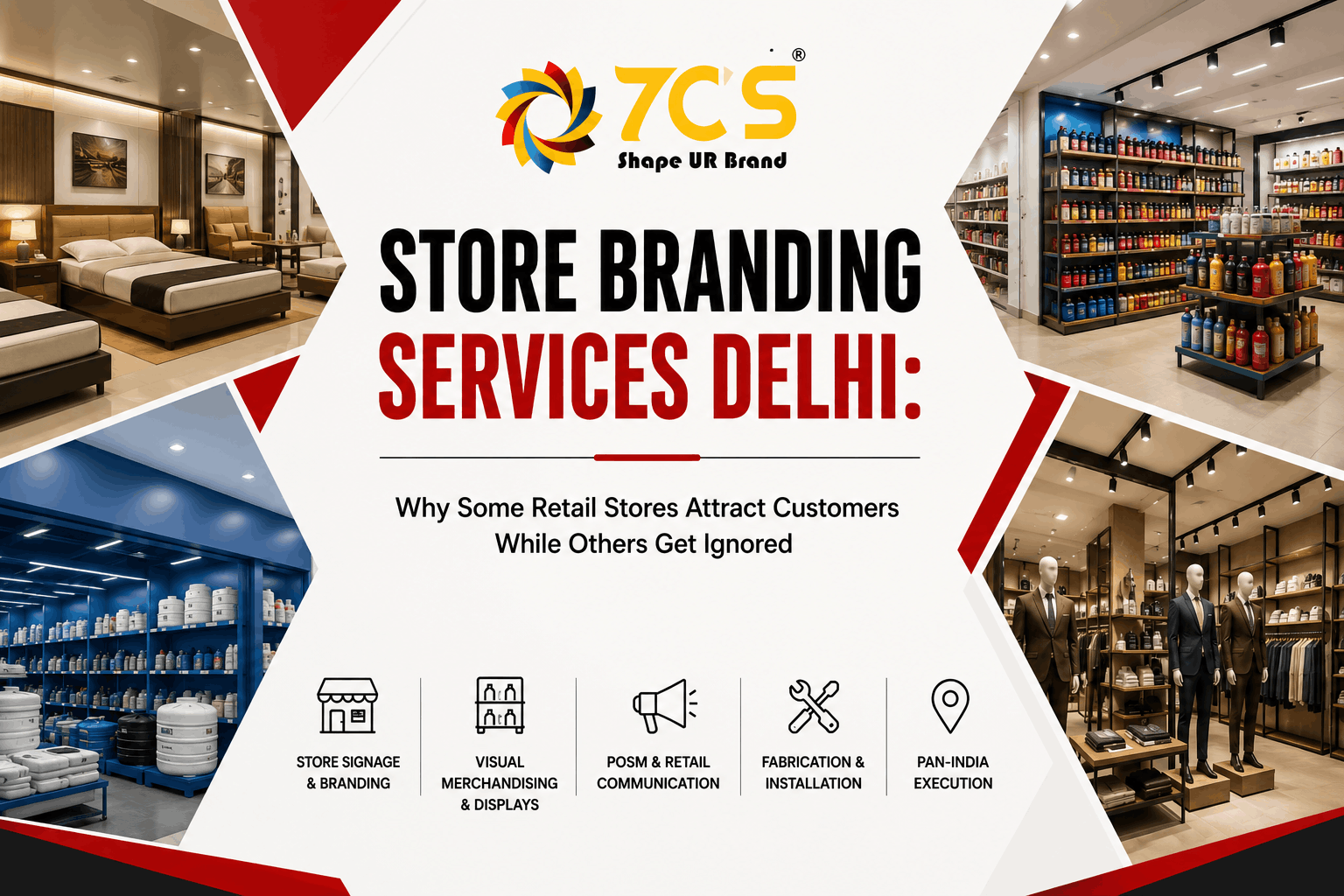
Store Branding Services Delhi: Why Some Retail Stores Attract Customers While Others Get Ignored
Key Takeaways
Store branding services Delhi go far beyond signage and paint. The stores that consistently attract customers are built on a precise understanding of shopper psychology, visual hierarchy, execution discipline, and brand consistency. Great products alone do not create great retail experiences. The environment around those products either earns customer trust or destroys it within seconds. 7CS Communication Pvt. Ltd., a Delhi NCR based retail branding and visual merchandising company, has executed large scale rollouts across India for brands like Kurl-on, Sintex, and Milton, and the lessons from those projects reveal exactly why execution quality separates the stores customers remember from the ones they walk past.
TL;DR
Store branding services Delhi are about creating retail environments that trigger the right psychological responses at the right moment. Customers decide within seconds whether a store deserves their attention. Inconsistent branding, poor execution, and weak visual merchandising silently destroy conversion rates and customer trust. This article explores the psychology behind those decisions, the elements that high performing retail brands get right, and what real world Pan-India rollouts teach us about execution quality.
What Are Store Branding Services Delhi?
Store branding services Delhi involve the design, fabrication, installation, and management of visual brand elements across retail spaces, including signage, displays, visual merchandising, POSM, and customer-facing brand environments. Retailers invest in store branding to create consistent, trust-building experiences that influence customer behaviour from the moment they approach a store to the moment they make a purchase decision.
The 7 Second Rule: How Customers Judge a Store Before Entering
Two stores selling identical products sit in the same busy market in Gurgaon. Same footfall. Similar pricing. Nearly identical product categories. One store generates consistent walk-ins throughout the day. The other struggles to hold attention for more than a glance.
This is not a hypothetical. It is a pattern that repeats across retail corridors in Delhi NCR, Noida, Faridabad, and every major retail market in India.
The answer almost always comes down to branding.
Store branding services Delhi have evolved because retailers finally understand what consumer research has been saying for years. Customers form a judgment about a store within roughly seven seconds of seeing it. That judgment is not rational. It is instinctive. It is built from visual cues, environmental signals, colour, lighting, signage clarity, and the overall impression of order and professionalism.
In those seven seconds, the brain is not reading product offers. It is assessing whether this environment feels trustworthy, whether it matches the customer's self image, and whether it appears worth the investment of time.
Stores that pass that instinctive test get footfall. Stores that fail it get ignored, regardless of what they sell.
This is the foundational reality behind every serious investment in retail store branding Delhi. The exterior of a store is not decoration. It is a filtering mechanism that either qualifies or disqualifies a customer before they ever reach the entrance.
Expert Insight: Most retailers think about branding as something that happens inside the store. Experienced retail branding consultants know that the decision to enter often happens from across the street. The storefront is the first and most powerful piece of communication a brand owns.
Retail Branding Services Delhi NCR and the Psychology of First Impressions
First impressions in retail are not just about aesthetics. They are about trust signals.
When a customer approaches a store, their brain runs a rapid pattern recognition check. It compares what it sees against every retail experience it has ever stored. Premium experiences, organised displays, clear signage, and consistent brand colours trigger a positive signal. Cluttered windows, faded graphics, inconsistent fonts, and unclear messaging trigger a warning.
That warning does not always translate into a conscious decision to avoid the store. Often it simply reduces the emotional pull. The customer slows down but does not stop. They glance but do not enter. They enter but do not engage deeply.
Retail branding services Delhi NCR are built to prevent that erosion of engagement at every stage of the customer journey.
The psychology of first impressions in retail rests on three pillars. The first is legibility, which means how quickly and clearly a customer can understand what the store sells and who it is for. The second is relevance, meaning whether the visual environment matches the customer's expectations for that product category. The third is aspiration, which is whether the environment makes the customer feel that entering it is consistent with how they see themselves.
Stores that score well on all three pillars do not need aggressive discounting to attract footfall. The environment does the selling before the product even comes into view.
Retail branding company Delhi NCR partners like 7CS Communication understand that every element inside and outside a store communicates something. The question is never whether the store is communicating. The question is whether it is communicating the right things.
Retail Display Branding Delhi Supports Product Discovery
Retail display branding Delhi is the mechanism through which products become discoverable. A well designed display system does not just hold products. It creates a visual conversation. It tells the customer which products are important, which ones are new, which ones are worth examining closely, and which category they have entered.
When display branding is executed poorly, the store becomes visually flat. Everything competes for equal attention, which means nothing receives attention. Customers who enter a flat visual environment tend to scan briefly and leave without engaging.
High performing retail brands use display systems to create deliberate visual rhythms. Contrast draws the eye. Hierarchy guides movement. Colour coding signals category boundaries. These are not design luxuries. They are functional tools that directly influence dwell time and conversion. To understand how the right display architecture drives this, explore how modular display systems Delhi support consistent product presentation across retail formats.
In-Store Branding Solutions Delhi Improve Navigation
Navigation inside a retail store is a branding problem, not just a layout problem. When customers cannot intuitively understand where to go, they feel mild anxiety. That anxiety is the enemy of relaxed browsing and impulse purchasing.
In-store branding solutions Delhi address navigation through consistent wayfinding systems, clearly branded category markers, floor graphics where appropriate, and logical visual flows that guide customers from entry to engagement to checkout without confusion.
The stores that handle navigation best are the ones where customers forget they are navigating at all. The environment guides them so naturally that movement feels effortless.
Why Great Products Alone Do Not Create Great Retail Experiences
This is perhaps the most important and most frequently misunderstood reality in retail.
The product is rarely the problem. In most competitive retail categories, product quality across brands at similar price points is comparable. What is not comparable is the environment in which those products are presented.
Perception precedes evaluation. Before a customer picks up a product, examines its features, or reads its pricing, they have already formed a feeling about it based entirely on the environment it sits in. A product displayed in a well branded, clean, logically organised environment is perceived as higher quality than the same product displayed in a cluttered, inconsistently branded environment.
This is not speculation. It is shopper psychology with decades of retail research behind it.
What Retail Managers Often Overlook: The brand perception a customer develops in the first thirty seconds inside a store is extremely difficult to reverse. A strong first impression creates a charitable lens through which everything else is evaluated. A weak first impression creates a critical lens. Retailers who focus exclusively on product and price while neglecting the branding environment are forcing every customer to evaluate their products through a critical lens.
Retail branding strategy must therefore account for perception as a product in itself. The environment is part of what the customer is buying. When a customer chooses to purchase from a well branded store, they are also choosing the experience, the feeling of confidence, and the trust that the environment communicated.
Retail Branding Strategy and Consumer Trust
Trust in retail is built through consistency and competence. Consistency means that every visual element in the store feels intentional and coordinated. Competence means that the execution quality of branding elements signals professional investment.
When signage is crooked, graphics are faded, display stands are damaged, or branding elements look like afterthoughts, the store communicates something very specific to the customer. It communicates that the brand does not care enough about this location to maintain standards. And if it does not care about standards here, the customer begins to wonder what else it does not care about.
Consumer trust is not built through advertising alone. It is built and destroyed through the accumulated experience of every physical touchpoint in a retail environment.
The Hidden Cost of Inconsistent Store Branding
Inconsistency is the silent killer of retail brand equity.
A brand that operates twenty stores across Delhi NCR, Mumbai, and Bengaluru but allows each location to develop its own visual personality is not building a brand. It is building twenty separate local impressions that share a name but nothing else.
The cost of this inconsistency is enormous, and most of it is invisible on the P and L. It shows up as suppressed repeat visit rates, lower average transaction values, reduced customer advocacy, and the inability to transfer brand equity from one location to another.
When a customer has a positive experience at a Milton or Kurl-on branded retail point in Noida, they carry that expectation to every other location they visit. If the next location looks completely different, feels less cared for, or delivers a visually inconsistent experience, the brand equity from the first visit is not just unused. It is actively contradicted.
Expert Insight: Customers Notice Inconsistency Faster Than Creativity
This is one of the most counterintuitive truths in retail branding. Brands invest significant energy in creating visually interesting store environments, and that effort is well placed. But customers who have visited one location of a brand and then visit another are not evaluating creativity. They are evaluating familiarity. Their brain is running a comparison against the stored impression of the first visit. Deviations from that impression, however minor, register immediately as something being off. A slightly different shade of blue on a display unit. A signage format that does not quite match. A layout that feels unfamiliar. None of these deviations is dramatic on its own. Together they communicate that the brand either does not have standards or cannot enforce them. Either conclusion undermines trust more effectively than any deliberate creative misstep would.
Store Branding Company Delhi and Multi-Location Consistency
Multi-location consistency is where most retail branding initiatives either succeed or collapse. The design may be excellent. The guidelines may be thorough. But if the execution across locations varies significantly, the brand experiences are fragmented.
A store branding company Delhi that operates at scale must have systems for ensuring that what is designed is actually what gets installed, at every location, to the same standard. This requires fabrication quality control, installation verification, geo-tagged documentation, and the operational capacity to manage rollouts across geographies simultaneously.
Retail Branding Services Delhi NCR for Franchise Networks
For franchise networks operating across Delhi NCR, Gurgaon, Faridabad, Ghaziabad, and beyond, consistency is not just a brand preference. It is a contractual and competitive obligation. Franchise customers choose a brand precisely because they expect a consistent experience regardless of which outlet they visit.
Retail branding services Delhi NCR built specifically for franchise networks must include standardised fabrication specifications, installation protocols, compliance verification systems, and ongoing maintenance guidelines that individual franchise operators can follow without requiring constant central oversight. To see how leading retail brands structure their full visual merchandising programmes, visit our visual merchandising services page for a complete overview of what a disciplined programme looks like in practice.
How Store Branding Services Delhi Influence Buying Decisions
The relationship between branding quality and buying decisions is direct, measurable, and often underestimated by retailers who think of branding as a cost rather than a revenue driver.
Store branding services Delhi influence buying decisions through multiple psychological mechanisms that operate simultaneously during the shopper journey.
The first mechanism is attention capture. In a busy retail environment, the brand elements that are most clearly executed capture the most attention. Attention is the prerequisite for all subsequent purchasing behaviour. A product that is not noticed cannot be considered. A category that is not clearly signed cannot be found. An offer that is not prominently displayed cannot influence the basket.
The second mechanism is confidence transfer. When a retailer invests visibly in the quality of their branding environment, customers transfer that perceived investment to their assessment of the products. The store that looks like it takes quality seriously is assumed to stock products that reflect the same commitment.
The third mechanism is dwell time extension. Well branded retail environments with clear navigation, engaging displays, and comfortable visual rhythms keep customers in the store longer. Every additional minute of dwell time increases the probability of purchase. Studies in shopper behaviour consistently show that dwell time is one of the strongest predictors of transaction value.
Visual Merchandising Services Delhi Create Better Shopper Experiences
Visual merchandising services Delhi are the operational expression of all the psychological principles described above. They translate brand strategy into physical reality through the precise placement of products, the construction of display hierarchies, the management of colour and contrast, and the ongoing maintenance of visual standards.
A visual merchandising programme that is well conceived but poorly maintained deteriorates quickly. Displays that were impactful on day one become cluttered and irrelevant within weeks if no maintenance system is in place. This is why visual merchandising is not a one time project. It is an ongoing retail management discipline.
Expert Insight: The best visual merchandising programmes are built around a simple question: what does the customer need to see, in what order, to make a confident purchasing decision? Every element in the store should answer part of that question or it should not be there.
The Elements of High Performing Retail Branding
Storefront Branding
The storefront is the most valuable real estate in any retail location. It is the point of maximum visibility and the primary driver of footfall decision making. High performing storefront branding communicates the brand identity clearly, signals the product category immediately, and creates enough visual interest to slow down passing traffic.
Effective storefront branding is not about being loud. It is about being clear. The brands that perform best at storefront level are the ones where a customer walking past at normal speed can instantly understand who the store is, what it sells, and why it might be relevant to them.
Visual Merchandising
Visual merchandising inside the store must create a layered experience. The first layer is macro, which is the overall visual impression of the store from the entrance. The second layer is mid-range, which covers the display systems, category markers, and product groupings visible from ten to fifteen feet away. The third layer is micro, which is the product level presentation, pricing communication, and POSM that engages the customer at arm's reach.
Brands that manage all three layers with discipline create retail environments where customers feel guided and confident rather than overwhelmed and confused.
Retail Signage
Retail signage is the language of the store environment. It communicates category, price, promotion, navigation, and brand values simultaneously. Poor signage is not just aesthetically unpleasant. It is functionally disruptive. It forces customers to work harder to find what they want, and effort is the enemy of purchase.
High quality retail signage is designed for legibility at the relevant viewing distance, uses consistent typography and colour standards across all locations, and is fabricated to a quality that reinforces rather than undermines the brand impression.
POSM
Point of sale materials are often treated as an afterthought in retail branding planning. This is a strategic error. POSM branding is the final layer of communication before the purchase decision. It is where offers are communicated, product features are highlighted, and the emotional case for purchase is made one last time.
POSM that is poorly designed, badly placed, or inconsistently executed wastes the investment made in every preceding stage of the customer journey. The customer has been guided to the right location by great storefront branding, navigated effectively by clear signage, engaged by quality display systems, and then abandoned by POSM that fails to close the conversation.
Display Systems
Display systems are the architecture of product presentation. They determine how products are grouped, how categories are separated, how new arrivals are highlighted, and how promotional priorities are physically communicated. A display system that is well engineered and correctly installed becomes an invisible guide. A display system that is poorly designed or badly installed becomes a physical obstacle. Learn more about how modular display systems Delhi are helping retail brands achieve flexible, scalable product presentation without compromising on brand consistency.
Brand Communication
Every surface in a retail environment that carries any message is performing brand communication. This includes wall graphics, ceiling hangers, floor decals, product tags, packaging presentation standards, and even the quality of the surfaces on which products rest. Brands that manage all of these touchpoints with consistency create immersive retail environments. Brands that leave them to chance create environments that feel accidental.
What Top Retail Brands Do Differently
The retail brands that consistently outperform their category share one operational characteristic above all others: they treat execution as a strategic function, not an operational afterthought.
Design quality matters. But design quality that is not matched by execution quality produces nothing of value. The brand that has spent months developing a comprehensive visual merchandising guide but then executes it inconsistently across locations has wasted both the investment in design and the opportunity it represented.
Top retail brands maintain execution standards through several disciplines. They create precise fabrication specifications that leave no room for interpretation. They build installation verification systems that confirm standards have been met before a location is considered live. They conduct regular compliance audits at retail locations to identify and correct drift from standards. They treat their retail branding partner not as a vendor but as a strategic execution capability.
Expert Insight: The gap between the brand as designed and the brand as experienced by customers is entirely determined by execution quality. This gap is invisible to senior brand managers who rarely visit retail locations. It is painfully visible to every customer who does.
Real Retail Branding Lessons from 7CS Communication Projects
The most valuable insights in retail branding do not come from theory. They come from the operational reality of executing large scale retail rollouts across diverse geographies, store formats, and brand requirements. 7CS Communication Pvt. Ltd. has managed exactly these kinds of rollouts, and the lessons from each project illuminate the gap between retail branding as a concept and retail branding as a practiced discipline.
Kurl-on: Consistency at Scale
The Kurl-on rollout managed by 7CS Communication involved the design, fabrication, and installation of over 2000 folding mattress display stands deployed across retail locations nationwide. A project of this scale immediately exposes every weakness in an execution system.
The core challenge in a rollout of this size is not fabrication. It is consistency. When display stands are being manufactured in volume and installed across hundreds of locations by multiple installation teams, the risk of variation is enormous. A stand that is two centimetres shorter than specification, a graphic that is slightly misaligned, a colour that has shifted fractionally during printing: these deviations are individually minor. Collectively, across thousands of units, they produce a brand experience that feels inconsistent and therefore unintentional.
The lesson from the Kurl-on project is that consistency at scale requires systems, not just intentions. Quality checks must be built into the fabrication process, not applied retrospectively to finished units. Installation verification must be documented rather than assumed. The brand standard must be defined so precisely that every person involved in the rollout understands exactly what success looks like, and every deviation from that standard is identifiable and correctable.
For retail brands operating across Delhi NCR and planning expansion into markets like Mumbai, Bengaluru, and Hyderabad, this lesson is directly applicable. The systems that allow consistent execution at thirty locations are the same systems that allow consistent execution at three hundred.
Sintex: The Intelligence of Documented Execution
The Sintex rollout managed by 7CS Communication involved over 600 installations and the deployment of approximately 20,000 branded assets, supported by geo-tagged reporting that provided verifiable evidence of installation completion and quality.
The introduction of geo-tagged documentation to retail rollout management represents a significant operational advance. For years, retail brands had to rely on self-reported installation completion from field teams, supplemented by occasional store visits from brand managers. The information asymmetry this created was enormous. Brands would believe their rollout was complete and their standards were met based on reports that could not be independently verified.
Geo-tagged reporting changes this entirely. Each installation is photographed and timestamped with location data at the point of completion. The brand team can review evidence of every installation without physically visiting every location. Deviations from standard are immediately visible in photographic documentation rather than remaining hidden until a customer complaint surfaces.
The deeper lesson from the Sintex project is that execution quality is a data problem as much as it is an operations problem. Brands that invest in rollout documentation systems gain visibility into the real state of their retail environment. Brands that do not invest in these systems are managing an impression of their retail estate rather than its reality.
For a brand operating across Chennai, Pune, Hyderabad, and other major Indian markets simultaneously, this visibility is not a luxury. It is the only practical mechanism for maintaining brand standards across a geographically distributed retail network.
Milton: The North India Rollout and the Discipline of Standards
The Milton rollout managed by 7CS Communication across North India provided a detailed examination of what multi-location branding consistency requires in practice.
North India presents specific execution challenges. The retail landscape across Delhi, Gurgaon, Noida, Faridabad, and Ghaziabad is fragmented. Store formats vary considerably. Location quality differs dramatically between premium mall environments and high street locations. Installation conditions range from straightforward to genuinely complex.
The discipline required to maintain brand consistency across this variety of conditions is considerable. It requires fabrication standards that are designed with real world installation variability in mind, not just ideal conditions. It requires installation teams that are trained to problem solve within brand standards rather than simply following instructions. And it requires a quality control process that is applied to outputs rather than just processes.
The Milton project demonstrated that retail branding execution quality ultimately comes down to the people involved and the systems they operate within. When both are excellent, consistent results across diverse conditions are achievable. When either is weak, inconsistency is inevitable.
Why Store Branding Fails Even When the Design Looks Good
This is a conversation that does not happen often enough in the retail branding industry.
Brands invest in design. They commission excellent creative work. They develop comprehensive visual merchandising guidelines. And then they hand the execution to a partner or internal team that does not have the fabrication capability, installation experience, or quality control systems to deliver what the design requires.
The result is a brand that looks excellent in the guidelines presentation and mediocre in the actual store. The design has not failed. The execution has.
Poor execution in retail branding takes several specific forms. Installation errors include display systems that are not level, wall graphics that are misaligned, signage that is mounted at the wrong height, and POSM that is placed in locations where it cannot be seen by the customer it is meant to engage.
Fabrication quality failures include materials that do not match specifications, printing that has colour shifted from the brand standard, structural elements that are not built to the durability requirements of a live retail environment, and surface finishes that deteriorate within weeks of installation.
Maintenance neglect is perhaps the most common and most damaging form of execution failure. A retail branding installation that was excellent on day one but has been allowed to fade, crack, tear, and accumulate damage over subsequent months communicates something very specific to customers. It tells them that the brand's commitment to quality is superficial and temporary. That is precisely the opposite of what the original investment was meant to achieve.
What Retail Managers Often Overlook: The maintenance schedule for retail branding elements is as important as the installation itself. A programme that does not include planned maintenance is not a branding programme. It is a one time decoration exercise with a guaranteed expiry date.
Store Branding Services Delhi: What Retail Brands Should Look for in an Execution Partner
Choosing a retail branding execution partner is one of the most consequential decisions a retail brand makes, and it is frequently made on the wrong criteria.
Price matters, but it is rarely the right primary consideration. The cost of poor execution, measured in wasted materials, reinstallation labour, delayed rollouts, and brand damage, almost always exceeds the savings from choosing a cheaper partner.
Experience in retail fabrication is the first criterion that should be evaluated seriously. A partner who has fabricated and installed retail branding systems at scale understands the difference between materials that look correct in a sample and materials that perform correctly under retail conditions. They understand the tolerances required for consistent results across a large number of units. They understand how retail environments stress materials in ways that are invisible in a showroom.
Pan-India execution capability is critical for any brand planning expansion beyond a single market. A retail branding partner that operates well in Delhi NCR but has no infrastructure or verified partner network for executing in Bengaluru, Chennai, Pune, or Mumbai is a partner whose value diminishes as the brand grows.
Quality control systems, including fabrication checkpoints, installation verification protocols, and photographic documentation, are non-negotiable for serious retail brands. These systems are the only reliable mechanism for ensuring that the brand experience delivered to customers matches the brand experience that was designed.
Rollout management capability covers the logistics of coordinating materials, teams, installation schedules, and reporting across multiple locations simultaneously. Poor rollout management produces the worst possible combination: some locations where branding is excellent and others where it is visibly inferior, creating exactly the inconsistency that destroys brand equity across a network.
7CS Communication brings all of these capabilities to retail branding projects across India, combining Delhi NCR based design and fabrication expertise with Pan-India execution infrastructure that has been tested across major rollout projects for established brands. To understand the full scope of what a professional retail branding engagement covers, explore our retail branding services page for a detailed overview of capabilities, service formats, and how we approach projects of different scales.
The Future of Store Branding Services Delhi
The retail landscape is changing in ways that make store branding services Delhi more important, not less.
Experiential retail is becoming the dominant model for physical stores that want to compete with online channels. In an experiential model, the brand environment is the product. Customers visit physical stores not primarily to transact but to experience the brand in three dimensions, to be inspired, to be engaged, and to feel something that a digital screen cannot replicate. This places an even greater premium on the quality, consistency, and thoughtfulness of every branding element in the physical environment.
Omnichannel branding integration is becoming a standard expectation. Customers who engage with a brand online and then visit a physical store expect visual and experiential coherence between both channels. The colours, imagery, typography, and overall brand personality they have encountered digitally should be immediately recognisable and seamlessly continued in the physical store. Retail branding solutions India that do not account for this integration are already behind the expectations of the connected consumer.
Sustainability in retail fabrication is moving from an optional brand value to a customer expectation and in some markets a regulatory requirement. Brands are increasingly specifying sustainable materials, recyclable display systems, and energy efficient signage technologies as part of their standard retail branding requirements. Fabrication partners who have not developed expertise in sustainable materials and processes will face growing limitations as this trend accelerates. For brands already thinking about this transition, our resource on sustainable visual merchandising India offers practical guidance on how to make environmental responsibility a genuine part of retail branding rather than a cosmetic addition.
Digital integration within physical retail environments is expanding the definition of what retail branding means. Digital display panels, interactive product information systems, and connected brand experiences that blend physical and digital elements are becoming more common across premium retail formats. The retail branding company of the future will need to integrate physical fabrication expertise with digital experience design capability to deliver the environments that leading brands will require.
Expert Insight: The stores that will lead retail in the next decade are already being designed today. The brands that treat their physical retail environment as a strategic asset, and invest in its design, execution, and maintenance accordingly, will capture the loyalty of customers who are increasingly choosing experience over price.
Frequently Asked Questions About Store Branding Services Delhi
What are Store Branding Services Delhi?
Store branding services Delhi refer to the complete range of design, fabrication, installation, and maintenance solutions that create a consistent and compelling visual brand experience across retail locations. This includes storefront branding, interior visual merchandising, retail signage systems, display fabrication, POSM development, and Pan-India retail execution services. Companies like 7CS Communication provide these services to retail brands operating across Delhi NCR and other major Indian markets.
How does store branding improve customer experience?
Store branding improves customer experience by creating a retail environment that is visually clear, emotionally engaging, and easy to navigate. Well executed branding reduces the cognitive effort required to find products, builds trust through visual consistency and quality, extends dwell time by creating an environment worth exploring, and reinforces the brand's quality positioning through every physical touchpoint in the store. The cumulative effect is a shopping experience that feels effortless and confidence inspiring.
What is included in retail branding services Delhi NCR?
Retail branding services Delhi NCR typically include storefront signage and graphics design and installation, interior visual merchandising systems, retail display unit fabrication, POSM design and production, wayfinding and category signage, wall branding and environmental graphics, fixture and display stand fabrication, installation management, quality verification, and ongoing maintenance services. For franchise networks and multi-location brands, services also include rollout management, compliance auditing, and geo-tagged installation documentation.
How much do store branding services cost in Delhi?
Store branding service costs in Delhi vary significantly based on the scope of work, number of locations, complexity of fabrication requirements, and the quality standards specified. A single store branding programme may range from a focused signage and display refresh to a comprehensive environmental redesign involving custom fabrication across all surfaces. The more relevant question for most retail brands is not what branding costs but what inconsistent, low quality branding costs in lost revenue, suppressed repeat visits, and brand equity erosion. Speaking directly with a retail branding company like 7CS Communication about project scope is the most reliable way to understand the investment required for a specific programme.
How long does a retail store branding rollout take?
Rollout timelines depend on the number of locations, complexity of fabrication requirements, geographic spread, and installation coordination requirements. A single location premium rebrand might take four to eight weeks from design finalisation to installation completion. A Pan-India rollout of the kind managed by 7CS Communication for Kurl-on, Sintex, and Milton requires detailed project planning, phased manufacturing schedules, and coordinated installation sequencing across multiple states, which typically extends across several months for large programmes.
Why does retail branding fail even with good design?
Retail branding most commonly fails not at the design stage but at the execution stage. Poor fabrication quality, inconsistent installation standards, inadequate quality control processes, and the absence of ongoing maintenance programmes mean that even excellent design delivers a mediocre or declining customer experience at store level. The brands that achieve and sustain great retail environments are the ones that treat execution quality as a non-negotiable strategic standard, not an operational variable.
Conclusion: The Store That Earns Attention Earns Revenue
Every day, across markets from Connaught Place to Cyber City in Gurgaon, from Sector 18 in Noida to high streets in Faridabad and Ghaziabad, retail stores either earn customer attention or lose it. The difference is rarely the product. It is almost always the environment in which the product lives.
Store branding services Delhi have evolved because the retail brands that understand this invest accordingly. They invest in storefront branding that creates curiosity from across the street. They invest in visual merchandising systems that guide customers effortlessly through the store. They invest in signage that communicates with clarity and consistency. They invest in fabrication quality that holds up under the daily pressure of a live retail environment. And they invest in execution partners who have the systems, the experience, and the operational capability to deliver brand standards at scale.
The return on that investment is not theoretical. It is measured in increased footfall, extended dwell time, higher conversion rates, stronger customer recall, better repeat visit frequency, and the compounding value of a brand that every customer encounter makes stronger rather than weaker.
Retail branding ROI is not immediate in every case. But over time, the stores that earn attention through consistent, high quality customer experience compound their advantage in ways that price-led competitors cannot replicate. A customer who trusts a store's environment trusts its products. A customer who trusts its products becomes a repeat visitor. A repeat visitor becomes an advocate. An advocate is the most efficient and most valuable form of brand communication available to any retailer.
7CS Communication Pvt. Ltd. exists to help retail brands build environments that earn that trust, consistently, at every location, across every market in India. Because the store that earns attention earns everything that follows.
Take the Next Step: Two Ways to Start
Download the Retail Store Branding Checklist
A practical, no-fluff checklist covering storefront evaluation, in-store visual merchandising standards, signage compliance, display system quality, POSM placement, and rollout verification criteria. Built from real project experience across Kurl-on, Sintex, Milton, and other Pan-India rollouts. Use it to audit your current retail environment or plan a new branding programme before a single rupee is committed.
Request your copy directly from the 7CS Communication team.
Book a Free Store Branding Consultation
If you are planning a new store launch, a network-wide rebrand, a franchise standardisation programme, or a Pan-India rollout and want a senior retail branding perspective on how to approach it, the 7CS Communication team is available for a focused, no-obligation planning conversation.
This is not a pitch. It is a working conversation that starts with your retail objectives and explores the branding, fabrication, and execution approach that will help you achieve them.
Reach out to 7CS Communication Pvt. Ltd. in Delhi NCR to book your consultation or request the checklist.