
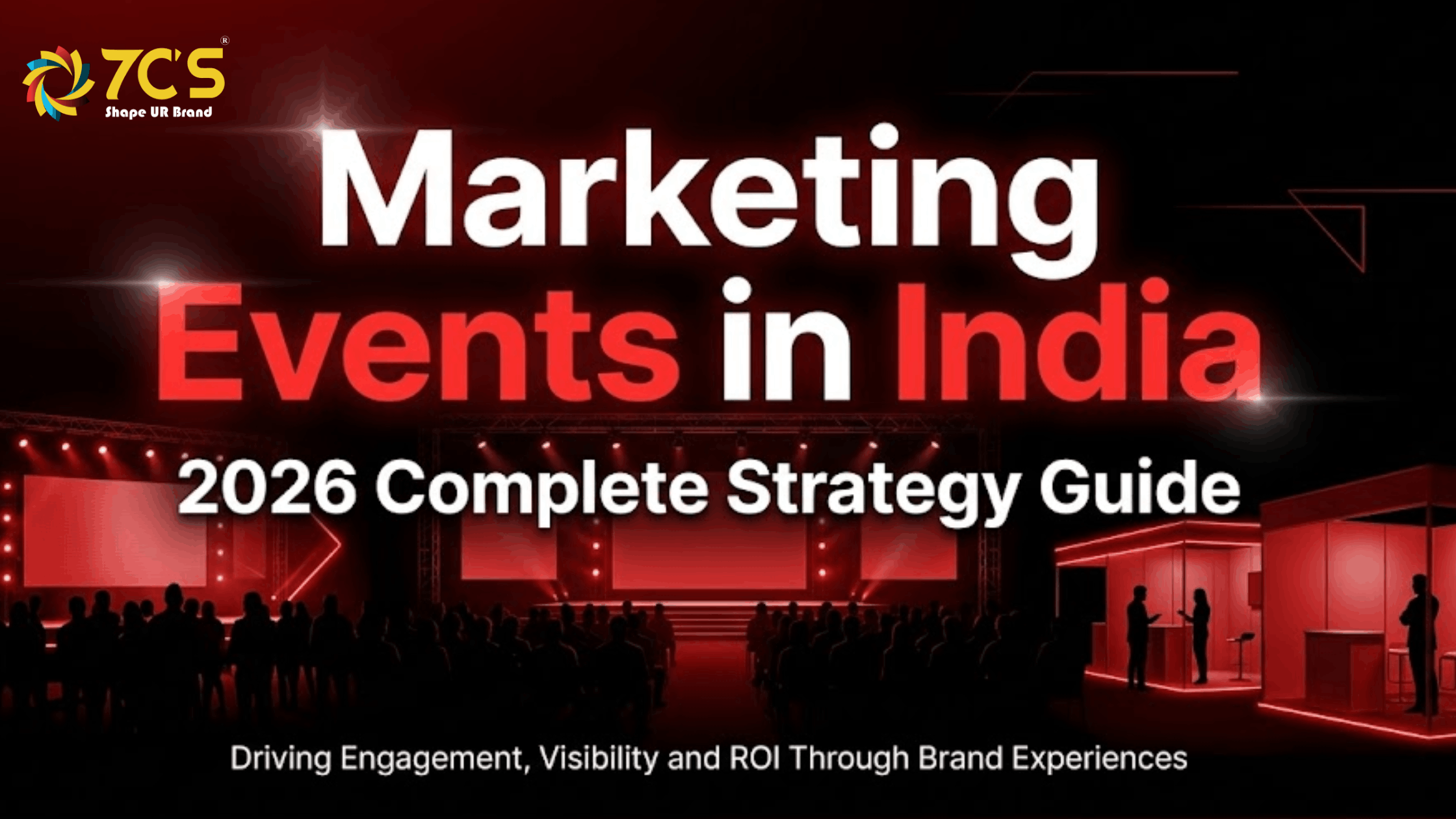
Marketing Events in India: The Complete Brand Strategy Guide for 2026
Marketing events in India have evolved from simple product showcases to full-scale brand experiences that shape consumer perception, drive loyalty, and deliver measurable business results. In 2026, as competition across every category intensifies, brands that invest in strategic event marketing are consistently outperforming those that rely solely on digital advertising. This guide covers everything you need to know, from types and strategies to planning, costs, and choosing the right event partner.
What Are Marketing Events in India?
Marketing events in India are organised, live experiences through which brands directly engage their target audiences. These range from product launches and corporate conferences to brand activations in malls, trade shows, and large-scale experiential campaigns across cities.
Unlike digital advertising, which competes for fragmented attention, a well-executed event places your brand at the centre of a controlled, immersive environment. The audience is present, attentive, and emotionally open. That combination is rare in modern marketing, and India's brands are increasingly recognising its value.
At their core, marketing events serve three purposes: they build awareness, they deepen brand relationships, and they convert interest into action.
Why Marketing Events Matter for Brands
India's consumer market is more discerning than ever. Brand loyalty is harder to earn, attention spans are shorter on screen, and advertising fatigue is real. Marketing events cut through that noise precisely because they are physical, human, and memorable.
ROI that compounds. A single well-executed event generates social media content, press coverage, word-of-mouth, and influencer moments simultaneously. The return on one event multiplies across channels and continues to deliver weeks after the day itself.
Stronger engagement. Research consistently shows that consumers who attend a brand event are significantly more likely to purchase, recommend, and remember the brand. Audience interaction at a live event creates emotional anchors that no banner ad can replicate.
Competitive differentiation. In saturated categories like FMCG, fintech, real estate, and fashion, brands that show up in person signal confidence, quality, and commitment. That signal matters to both consumers and B2B buyers.
Marketing Event Trends in India (2026)
Marketing events in India are evolving rapidly as brands shift towards more experience-driven and measurable formats. In 2026, several key trends are shaping how events are planned and executed.
Experience-first events. Brands are focusing on immersive formats that prioritise interaction over passive viewing. Consumers expect to engage, not just observe.
Tech-enabled event experiences. LED integrations, AR/VR elements, and real-time digital amplification are becoming standard in high-impact events.
Hyperlocal targeting. Events are being tailored to specific cities and audiences rather than one-size-fits-all campaigns.
Faster execution cycles. Brands are moving towards modular setups that can be deployed quickly across multiple locations.
Data-driven event planning. Every event is now measured for leads, engagement, and ROI, making events more accountable as a marketing channel.
Types of Marketing Events in India
Understanding the landscape of event formats helps brands choose the right approach for their specific objectives.
Corporate Events
Corporate events include conferences, annual meets, leadership summits, townhalls, and award ceremonies. These are essential for B2B brands, enterprise companies, and organisations looking to reinforce internal culture or build industry authority. Corporate event management in India has grown significantly, with Delhi, Mumbai, and Bengaluru serving as the primary hubs for large-scale corporate gatherings.
Brand Activations
Brand activation services in India focus on creating direct, participatory moments between a brand and its consumers. These are typically short, high-impact experiences placed in high-footfall locations such as malls, airports, metro stations, and college campuses. The goal is not just visibility but genuine brand engagement that changes how a consumer feels about a product.
Product Launches
A product launch event in India is a strategic moment to shape first impressions, generate media coverage, and build initial momentum. The format can range from an intimate press preview to a large public reveal, depending on the product category and target audience. Executed well, a launch event becomes the anchor for an entire integrated campaign.
Exhibitions and Trade Shows
India hosts some of Asia's largest trade exhibitions across sectors including auto, retail, technology, real estate, and fashion. Participating in these gives brands direct access to buyers, partners, distributors, and media in one concentrated environment. For B2B brands in particular, exhibition presence is often a core part of their annual event marketing India strategy.
Experiential Marketing Events
Experiential marketing events go beyond showcasing a product. They invite consumers to live the brand, through interactive installations, sensory experiences, gamification, and storytelling environments. An experiential marketing agency in India designs these with deep attention to consumer behaviour, creating moments that feel personal even at scale.
Event Marketing Strategies in India That Actually Work
Generic strategies produce generic results. Here is what effective event marketing actually looks like in the Indian context.
Hyperlocal targeting. India is not one market. A campaign that works in South Delhi will not automatically resonate in Lucknow or Coimbatore. Brands that invest in regional customisation, language-appropriate messaging, culturally relevant activations, and locally familiar influencers consistently outperform those running uniform national campaigns.
Phased event calendars. Rather than treating events as one-off moments, leading brands in India plan them as a connected calendar. A product teaser activation in month one, a major launch in month three, a consumer engagement roadshow across Tier 2 cities in month five. Each event feeds the next.
Integration with digital. Every physical event should have a digital amplification plan built in before it begins. This means pre-event social buzz, live content from the venue, post-event highlight reels, and PR outreach. Events that live only in the room are wasted opportunities.
Audience data capture. Events are one of the most effective ways to build qualified first-party data. Registration forms, on-ground contests, QR-based interactions, and post-event surveys all create a data asset that continues to be useful long after the event itself.
Measurement from day one. Define what success looks like before the event is designed. Footfall, leads generated, social impressions, media pickups, samples distributed, surveys completed. Brands that measure rigorously are the ones that scale their event investment intelligently.
For example, many FMCG brands in India run mall activations across cities like Delhi and Mumbai to drive product trials, while real estate companies use large-scale launch events to generate high-value leads within a short time. Similarly, tech brands often combine product launches with influencer-led experiential campaigns to maximise reach and engagement.
The Role of Event Planning Services for Brands in India
Behind every successful marketing event is a structured planning process, and most brands increasingly rely on specialist event planning services for brands in India rather than managing it in-house.
A capable event planning partner brings creative concepting, vendor networks, venue intelligence, logistical execution, on-ground staffing, and post-event reporting together under one roof. This is not just convenient. It directly reduces cost, improves quality, and protects the brand from on-ground disasters that inexperienced teams routinely face.
Choosing the right event planning partner is a strategic decision. Look for demonstrated experience in your industry category, clarity in cost structure, creative portfolios that show versatility, and references from brands at your scale.
Corporate Event Management in India: What Brands Need to Know
Corporate event management in India has become a specialised field, particularly in metro cities where the volume and complexity of business events is high. Delhi NCR, Mumbai, Hyderabad, and Bengaluru together account for the majority of corporate events held in the country each year.
For B2B brands, corporate events serve multiple functions simultaneously. They are relationship-building platforms, thought leadership stages, sales enablement tools, and internal culture reinforcement mechanisms. A well-managed corporate event shapes how a company is perceived by its industry, its clients, and its own employees.
The key to effective corporate event management is alignment between the brand's business objectives and every element of the event experience, from the speaker roster and stage design to the networking format and post-event content.
Brand Activation and Experiential Marketing in India
Brand activation services in India have matured considerably over the last decade. What was once limited to in-store sampling has expanded into immersive pop-ups, city-wide campaign integrations, augmented reality installations, and co-branded experiential hubs.
The most effective brand activations in India share a common trait: they are built around genuine consumer insight. They understand what the audience cares about, what they find surprising or delightful, and what motivates them to share an experience with others.
Experiential marketing campaigns work because they create emotional connection at a moment when the consumer is physically present and engaged. That emotional connection is what drives brand preference in competitive categories. An experienced experiential marketing agency in India will design activations that are not just visually striking but behaviourally intelligent, structured to move consumers from awareness to consideration to advocacy within a single interaction.
How to Plan Successful Marketing Events in India
Planning a marketing event that delivers results requires a disciplined approach. Here is a framework that works.
Step 1: Set clear objectives. Define what the event must achieve. Brand awareness? Lead generation? Product trial? Internal engagement? Objectives determine every subsequent decision.
Step 2: Know your audience. Identify who you are trying to reach, where they are, what they care about, and how they prefer to engage. The event format, venue, content, and experience should all flow from this understanding.
Step 3: Choose the right format. Match the event format to the objective. A corporate conference for thought leadership. A mall activation for product trial. A roadshow for Tier 2 market penetration. A launch event for media and trade engagement.
Step 4: Build the execution plan. This includes venue selection, vendor partnerships, creative development, staffing, technology, logistics, and communication timelines. Each element requires dedicated ownership and contingency planning.
Step 5: Measure and learn. Capture data throughout the event. Analyse results against your defined objectives. Use those insights to improve the next event in your calendar.
Marketing Events and the Broader Brand Experience Ecosystem
Marketing events do not exist in isolation. The most effective brands in India treat events as part of a connected brand experience ecosystem that includes visual merchandising services in India, retail branding, and digital communications.
Brands that combine marketing events in India with structured event planning services, retail branding, and visual merchandising consistently achieve stronger engagement, higher recall, and better conversion outcomes.
A consumer who encounters a brand through a powerful activation, then walks into a retail environment that carries the same visual language and messaging, and then sees the same brand story reinforced online, experiences something far more compelling than any single touchpoint can create. This is why leading brands work with partners that can bridge event marketing with retail branding agency in India expertise and broader visual merchandising strategy.
Event marketing India works best when it is integrated into a larger campaign architecture where each channel amplifies the others. This connected approach builds topical authority with consumers, strengthens brand recall, and creates compounding returns on marketing investment.
Why 7C's Communication for Marketing Events in India
7C's Communication is a Delhi-based event marketing and brand experience agency with pan-India execution capabilities. The team brings together event planning, brand activation, corporate event management, and experiential marketing under one integrated offering.
Rather than treating events as standalone productions, 7C's builds each event as part of a broader brand strategy, ensuring that every activation connects to the client's business objectives and delivers measurable outcomes. With experience across sectors including FMCG, retail, real estate, financial services, and technology, the agency brings both creative depth and operational discipline to every brief.
For brands looking for a partner that understands both the complexity of the Indian market and the demands of modern brand building, 7C's Communication offers the strategic and executional capability to make that happen.
Frequently Asked Questions
What are marketing events in India?
Marketing events in India are live, organised experiences through which brands directly engage their target audiences. They include product launches, brand activations, corporate conferences, trade shows, and experiential campaigns designed to build awareness, drive engagement, and generate measurable business outcomes.
What are the main types of marketing events in India?
The main types include corporate events and conferences, brand activations, product launches, exhibitions and trade shows, and experiential marketing events. Each format serves different objectives and is suited to different audience types and brand goals.
How much do marketing events cost in India?
Costs vary significantly based on scale, format, city, and complexity. A small brand activation in a single location can start from a few lakhs, while a large-scale experiential campaign across multiple cities can run into several crores. Working with an experienced event planning partner helps brands optimise spend and maximise return.
How do I choose the right event management company in India?
Look for demonstrated experience in your category, a clear creative and strategic process, transparent cost structures, a strong vendor and venue network, and verifiable references from brands at your scale. An event management company in Delhi or other metros with pan-India capabilities offers the widest execution reach.
What is the ROI of marketing events?
ROI depends on your defined objectives. Events generate returns across multiple dimensions simultaneously, including leads, media coverage, social content, consumer data, and direct sales. Brands that define success metrics before the event and measure rigorously consistently demonstrate strong returns from event investment.
What is experiential marketing and how is it different from regular events?
Experiential marketing creates immersive brand experiences that invite consumers to participate, not just observe. Where a traditional event might present a product, an experiential marketing event allows consumers to interact with, feel, and emotionally connect with the brand. The result is deeper engagement and stronger recall.
What is brand activation and why does it matter?
Brand activation is a marketing strategy that brings a brand to life through direct consumer interaction, typically in high-traffic physical spaces. It matters because it creates real-time, personal brand experiences that drive trial, advocacy, and emotional connection in ways that passive advertising cannot.
Can small and mid-size brands benefit from event marketing in India?
Absolutely. Event marketing is scalable. A targeted regional activation or a well-executed local launch event can deliver significant brand impact for smaller brands. The key is matching the event format and scale to the brand's objectives and budget, rather than trying to replicate large-scale campaigns with insufficient resources.
Conclusion
Marketing events in India remain one of the most powerful tools available to brands that are serious about building lasting market presence. In 2026, with digital channels growing noisier and consumer expectations rising, the ability to create meaningful live experiences is a genuine competitive advantage.
Whether you are planning a corporate summit, a citywide brand activation, or a product launch designed to dominate the news cycle, success comes down to strategic clarity, creative execution, and a partner who understands both.
If your brand is ready to move beyond impressions and create measurable impact, investing in structured marketing events in India is no longer optional.
Connect with 7C's Communication to plan high-impact brand events that drive engagement, visibility, and real business results across India.